
Marketing 2.0 has brought new ideas and enabled the growth of engaging communication methods. Businesses are slowly realizing the importance of social media and the necessity to be seen online. This leads to Inbound Marketing (which we will discuss soon in upcoming articles) and one of its main parts: Content Marketing.
Thus, we see various blogs thriving online and I feel pleased! I read many of them. I am a blogger. I have been writing on the Internet for several years. From the start, I have spent time sharing on websites. Movie or music reviews, articles for artists and composers, tips on communication, and more.
The perverse effect of Content Marketing
However, if the Marketing 2.0 trend tends to put people at the center of our communication and a certain drift is spreading from our exchanges (even if it seems to me that it has always existed): many write their articles with the sole goal of SERPS results and lead generation.
These are not necessarily large companies, they are often freelancers, apprentice coaches, communication consultants, etc. In short, often by those who know how SEO works. This discipline has always given rise to borderline actions, with some navigation, more or less expert, within the limits of Google’s permissions.
Articulos que te pueden interesar 8 causes of content marketing failure
The result is reflected in the content. Beyond a catchy title (“The 10 Ridiculous Secrets to Increase Productivity,” “The Only Way to Reach 10,000 Followers in a Week,” “The Incredible Trick to Make You the Envy of All Your Competitors”), the meat of the article no longer has any flavor. Some strange turns of style (this one for example, taken from a popular blog: “Don’t you want to stop having traffic?”, sic!), keywords in large numbers to the point of altering the meaning of the article and mixed contents coming from multiple competing sites. At the end of the article, what did we learn from it? Wind! Newspaper headlines are often much more promising than broadcast information. What a buzz, my brother, what a buzz!
Without going that far, many of us try to maximize the reach of our writing by thinking first and foremost about the Google effect rather than the interest of our readers.
Write your articles in just an hour!
This is a topic that has caught my attention recently. The blog that proposes it is of quality and I understand the idea that emerges from this article, but seriously, an article in an hour? The reason is simple. To be well indexed by the Mountain View company, you need to provide content regularly, or even very regularly. Three articles a week would make a significant jump in the SERPS.
Articulos que te pueden interesar WordPress: 13 plugins I use every day
Google interprets the regular publication of content as an indicator of the good health of the site and, although it claims to partly detect the quality of the articles, in reality it only understands a certain form of semantics, including the code of the page and the regularity of the keywords. The context analysis and interest of the article go over his head.
Readers first!
Google accounts for 90% of web searches. It doesn’t respect your work, it dominates the web and dictates to each of the content producers how they should write and promote it. He lets himself be bought (AdWords), he is not loyal (the rules of the game change too often), he no longer shows you the keywords that bring your visitors to your site to make you spend a few euros,… In short, he is not a good friend! And it is an incredible dictate that weighs on the shoulders of each of us.
Should I create a title with less than ten words and three keywords because that’s Google’s rule? If that happens, Google will kill editorial quality. We can already see it today, the titles of articles on the internet, but this is increasingly true also for the printed paper, have lost the originality, inventiveness, double meanings and second-rate humor of the past. SEO (but not only) has changed journalistic writing to deliver us a tasteless dish. Pasta with butter is good every now and then, but every day…
Hot topics are covered urgently, copied and pasted from the AFP dispatch or any English-speaking site. The most important thing is to talk about the topic, appear in Google Trends! To this I prefer to take the time to cover the topics.
I’m not a model, it’s true. I find mistakes months later in my articles and there are certainly many that I will never see, the style can be improved, but I try to give my best. This is one of the reasons my articles aren’t more numerous. I need time. A long time.
I write for my readers, to help them as much as possible, to sell my services (all the same!) and show where I am an expert. I don’t write focusing on what Google will think of my article. I try, as much as possible, to honor those who give me the pleasure of reading me or following me on social networks. I always consider it a privilege and not a given.
Do you want to write for humans or robots?
What if we changed strategy?
I’m not going to give you a utopian line like «What if everyone stopped using Google?» » We are tied hand and foot, we are all looking for traffic on our sites and we don’t want to be smart in the face of the omnipotence of the god of the Internet. However, the arrival of social networks has created a new paradigm. If we were to rely mainly on Google and some directories on the Internet, today we have the ability to create communities and rely on them.
I’ve been adopting this strategy for a while now. By focusing on the numbers that Analytics provides me, I know that with the search engine I am casting a wide net, that the bounce rate can be high and that I am not necessarily only involving people who are truly interested in my content or my services. On the contrary, social networks bring me readers, most of them loyal, and of whom I know that they follow me, largely, due to their interest in my sector of activity, my services or my publications. When they are no longer interested, they stop following me. I therefore prefer to rely on SMO advice rather than SEO (although I don’t rule it out completely, as I was saying, you can’t be too smart).
I prefer to focus on quality rather than quantity. I’m not looking for tens of thousands of visitors a day. No, I will never buy likes, followers, etc. This is due to a certain ethic and the need for authenticity in my sharing and exchanges. Am I worth tens of thousands of followers? Of course not, so there is no need to buy dark and fake accounts.
I think work is the best value to get real recognition. It takes more time, of course.
A blog? My little cousin has one!
As I said at the beginning of the article, I am a blog enthusiast and consume all types: fashion, cooking, marketing, new technologies, etc. I often find excellent information or in-depth articles there and this article is not intended to denigrate this media. Who would have seen the branch he is sitting on?
However, it seems to me that we are arriving at a period of overflow, of excessive consumption of information and that the blogosphere risks paying the price for the lack of seriousness of some of its members. In order not to lose credibility, it therefore seems essential to offer your readers attentive content in equally accurate packaging.
Whether it’s professional, whether it talks about one of your passions, it doesn’t matter, take care of your content and the rest will come. Word of mouth on social networks seems much more convincing to me than a few keywords scattered on my site. I look forward to your reactions! And no matter what we think, Google expects only one thing: that you take care of your readers!
latest posts published

Personal Branding or cult of personality?

6 Key SEO Steps Before Launching a New Website

Communicating during the financial crisis

11 good resolutions to give a boost to your 2019

It all starts with an idea

6 marketing and creativity books to read this year!

Content Marketing: Do You Really Have to Offer All Your Content?

Entrepreneurs and content marketing: 16 quotes to encourage you
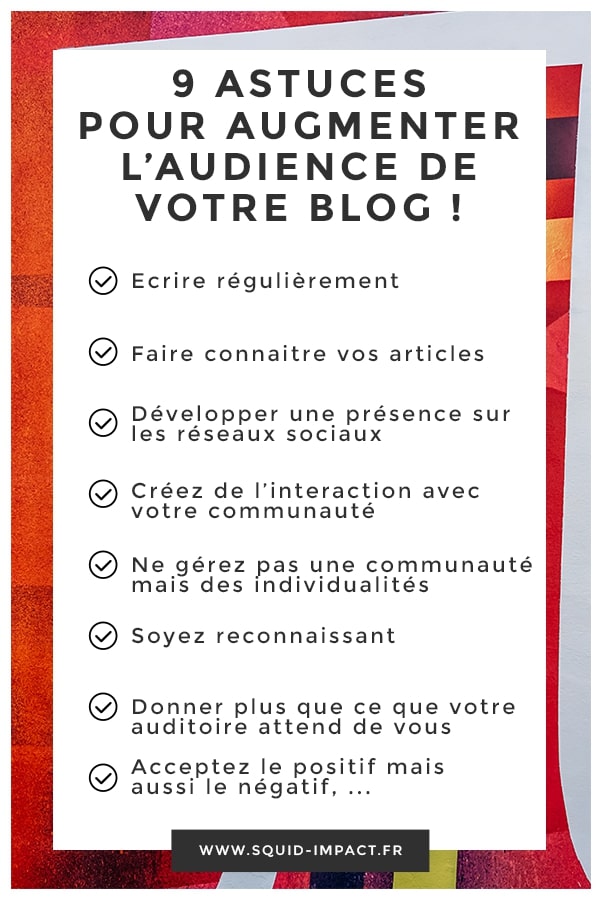
9 tips to increase your blog audience!