Of all the forms of communication imaginable, provocation is a delicate art. Some have made it their lifestyle or their business, like a large number of comedians, with more or less success. The Latin root of the word “provoke” (provoke) has the meaning “ call«. In this sense, arouses curiosity, rekindles the interest of the recipient of the message.
In a particularly obstructed media field (we receive several thousand commercial stimuli a day), making one’s voice and message heard becomes a difficult task. How then to attract the attention of the consumer, already saturated with radio, TV, internet, posters, magazines and newspaper advertising? The originality and intelligence of a campaign often hit the mark and, obviously, provocation is one of the weapons that allows you to win over your audience.
Good communication does not just touch the reasoning of its interlocutor, it will shake him in the field of emotions and feelings. Joy, sadness, desire for elsewhere, nostalgia, jealousy are all arrows that strike the consumer’s heart.
Provocation never leaves one indifferent. It will make you smile, think or annoy, but there will always be a return.
Articulos que te pueden interesar The tax on IoT products and solutions
It’s in our genes!
 Some brands have made it their DNA. We will mention of course Benetton which produced a large number of advertising posters, without displaying any of its products, simply focusing on a subversive message. At the beginning of the 80s Benetton posters were very colourful, they played on ethnic roots, flags and anti-racism. We are then in the “Don’t touch my friend” years. Gradually, the brand’s clothing disappears and focuses only on a message of tolerance.
A turning point came in the early 1990s, notably with a campaign banned in Italy that showed a priest kissing a nun. The message is now oriented towards current topics. Focusing from time to time on nudity, on difference, on sex or on religion, Benetton will tackle AIDS, racism, war or disability.
In 2011, as the brand began to decline, a new campaign called “UnHate” was born, featuring several characters kissing, including a same-sex kiss between Pope Benedict XVI and the Sunni imam of Egypt’s Al-Azhar University, Ahmed el Tayyeb. There is a deluge of protests against the brand. The Vatican is even talking about criminal proceedings. Faced with these threats, Benetton withdraws this photomontage and apologizes. This campaign will even be considered vulgar and pathetic by Oliviero Toscani, former photographer (since 1983!) of the brand and yet the author of a large number of sulphurous campaigns.
If this series of posters has allowed it to return to the media spotlight and in the minds of consumers, it does not mean that Benetton’s appeal capital has improved (nor its market shares). But is a brand legitimate as a social and political actor? Above all because he has an interest in being irreproachable on these fronts.
Articulos que te pueden interesar 4 out of 10 employees use tablets in their workspace
Stand out to survive
The journalistic return of September 2014 is marked by the sign of the political reshuffle. After a turbulent weekend for Messrs. Montebourg and Hamon, we begin this week with the failure of Manuel Valls’ government and on Tuesday those who will have to roll up their sleeves to face this difficult start to the school year will be announced.
Arnaud Montebourg, the rebel, the polemicist, the social network agitator, is back in the news. Accustomed to provocations and shocking little phrases, I decided to add it to this article.
This small provocation allowed him to return to the limelight and distinguish himself from a moribund government. Better yet, his small coup brings him the support of a part of the left-wing electorate, disappointed by the current president, who sees him as the probable successor for 2017.
Time has shown us that his strategy was far from bearing fruit since he left politics. Communication (especially political) is a vast game of chess, every movement of the pawn has its importance.
Positioning compared to the competition
Freewith his image as a troublemaker on the internet, he played on provocation several times, thus working on his image as an outsider and as an operator closest to the people and anti-system. The provocation occurred on a competitive level, with Free not hesitating to define the customers of competing mobile operators as «pigeons». No shocking images (apart from one of the first free ads shown below), just a differential positioning policy that will not always please the historic trio. Furthermore, the Paris Commercial Court will condemn Free Mobile to pay 25 million euros to Bouygues Télécom for «disparagement and unfair competition».
The failed attempts
It’s not uncommon for brands to try provocative or playful humor, with varying degrees of subtlety. At the beginning of the 1970s, the BNP bank, associated with Publicis, launched a campaign that left its mark and caused a stir. On the posters, a banker with a predatory look and smile dares to admit: “ To put it bluntly, I care about your moneyFar from the reassuring image of the usual communication from banks, this one sends shivers down the spine.
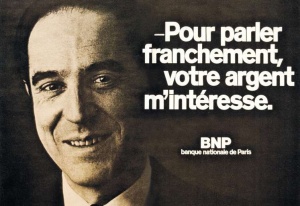 However, this image will allow BNP to emerge from the shadows and compensate for its image deficit. If the idea is good there is certainly a casting error on the character representing the company. Consumers are not reassured by the character and internally no one wants to be associated with this unpleasant guy.
Closer to us, society Numeric I tried a little macho humor with the formula “ Get it as soon as your wife changes her mind«. On social media the formula is not unanimous, but the objective is achieved: we are talking about Numéricable for a joke that is not very bad after all. It is not the first attempt by the FAI given that in the Paris metro a previous poster campaign made fun of the capital’s rents.
 This type of humor will never be unanimous, but these cases are quite funny and have not led to major negative feedback. On the contrary, the message is purely commercial and does not attempt to provide new insights or particular reflections. Nor does it attempt, as Benetton can do, to interact with current events. It’s a difficult balance to strike: shock enough to get people talking, generate enough negative reactions to fuel debate, and then be able to repeat the feat without getting burned!
Above all, don’t forget, you don’t need to be subversive to make an impact or break out of oblivion! The “real” campaigns of Dove I’m a good example of that. Far from the market leaders, Dove chooses to distinguish itself by supporting a new form of discourse among beauty product manufacturers. Since 2004, Dove has highlighted women whose bodies don’t fit the usual advertising beauty standards. Armed with different means of communication (posters, TV commercials, web videos, etc.), the Dove campaign creates buzz, speaks to women and brings incredible results, both in terms of awareness and market share.
“Shock advertising” to raise awareness
Provocative and trashy advertising is the perfect place to make an impression. Road Safety uses it every year, as do anti-smoking adverts and Amnesty International. Shocking images to fight against addictions, against accidents, against torture, world hunger, global warming, many topics that deserve everyone’s attention.
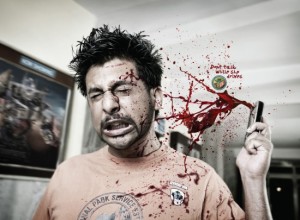 This is the most legitimate sector to use this form of communication, but faced with the multiplication of these shocking images, aren’t we risking a dangerous addiction? In the same way that violence and sex in cinema ended up becoming commonplace up to a certain point (let’s compare a crime film from the 1950s with one from today, the difference is clear), don’t we risk losing impact due to the overabundance of shocking messages? Campaigns are becoming increasingly trashy to get noticed by the public.
When will we reach the point of no return? Is there a tolerance threshold beyond which the message produces the opposite effect? Rather than visual shock, can’t we focus more on psychological shock?
The benefits of provocation
It provokes debates
There’s nothing like going against general thinking to spark a discussion. This is what we recommend to writers and bloggers: write a few articles like this and you will get reactions. All that remains is the dosage to manage…
Raise questions
Once the public’s attention is captured, a well-orchestrated campaign will raise questions. On issues such as the fight against tobacco, road safety, etc., this is the desired objective.
It can have educational virtues
Once we get past the question phase, we hope the audience learns the lessons… and applies them! Television advertising campaigns are not enough to change behavior, but a global prevention campaign (associated for example with other elements such as traffic repression) allows for convincing and long-lasting results to be achieved.
The risks of provocation
The main risk is pushing yourself too far, wanting to do too much and burning your wings. The phrase is quick (especially in the era of social networks): the bad buzz ! Building your company’s image is long and tedious work, destroying it is extremely fast!

latest posts published

Personal Branding or cult of personality?

6 Key SEO Steps Before Launching a New Website

Communicating during the financial crisis

11 good resolutions to give a boost to your 2019

It all starts with an idea

6 marketing and creativity books to read this year!

Content Marketing: Do You Really Have to Offer All Your Content?

Entrepreneurs and content marketing: 16 quotes to encourage you
9 tips to increase your blog audience!